Traffic delays down 11% as travel grew 13%
Nov. 19, 2026
By Staff
AUSTIN – Targeted congestion relief projects are paying off for Texas commuters, saving drivers time and money across the state.
The 2026 Texas Top 100 Congested Road Segments Report identifies the state’s most congested roadways. As the Texas economy and population grow, the Texas Department of Transportation (TxDOT) is meeting rising demand with a record number of projects.
Nearly half of the roads identified in the report are already under construction.
Delays down, savings up for commuters
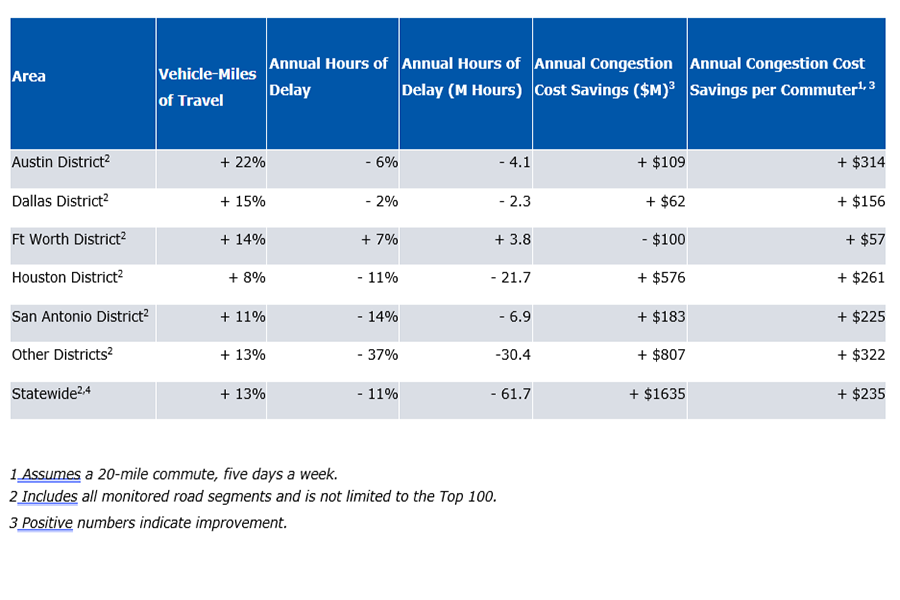
The report compares 2025 conditions with 2017, a recent peak for congestion in Texas. Even as statewide travel grew 13%, statewide delay is still down 11%.
Those gains saved Texas commuters an estimated $1.6 billion in delay and fuel costs in 2025 compared with 2017, or about $235 per commuter each year.
“We’re targeting construction where it can make the biggest difference, focusing directly on some of the state’s most congested roads,” TxDOT Executive Director Marc Williams said. “Even as more people travel on Texas roads, delays are down statewide. That’s real progress — and it shows our investments are working to save Texans time and money.”
In the Rio Grande Valley, the I-2/I-69C interchange project cut annual traffic delay on two segments of I-2 by 96%, improving the ranking of one segment from 95 to 1,653 and another segment from 103 to 1,669.
“Texas is proving that growth doesn’t have to mean gridlock,” Texas Transportation Commissioner and Texas Clear Lanes Chair Robert C. Vaughn said. “As more people travel our roads, delays are continuing to decline. Texans are spending less time in traffic and more time where they want to be with their families, friends and communities.”
Texas Clear Lanes
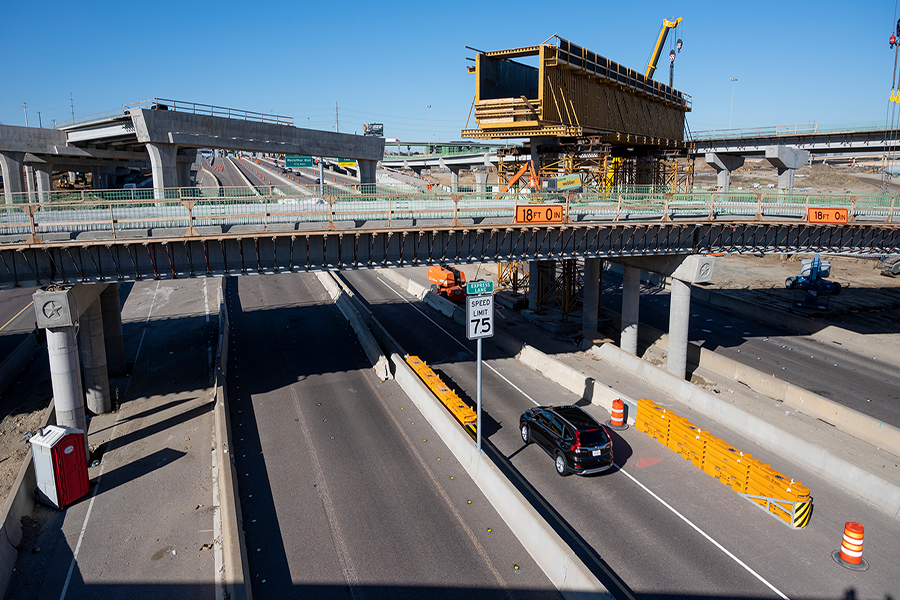
The Texas Clear Lanes program targets congestion in the state’s largest metro areas. TxDOT projects in smaller cities are also delivering relief as work is completed.
In 2025, 41 of the Top 100 congested road segments were under construction, including several Texas Clear Lanes projects.
“Movement of people and goods in Texas are at their highest levels ever, but Texans are experiencing less congestion than they were seven to 10 years ago,” said Luke Albert, Texas A&M Transportation Institute (TTI) Research Engineer. “That’s a direct reflection of the commitment to funding and delivering projects and other congestion relief measures, especially the Texas Clear Lanes program and other mobility-improving initiatives throughout the state.”
Roadway highlights
- Houston: The I-610 at SH 288 Texas Clear Lanes project has cut annual traffic delay by 65%, improving the ranking from 25 to 96.
- Austin: Partial completion of the US 290/SH 71 at Oak Hill Texas Clear Lanes project has cut annual traffic delay by 40%, improving the ranking from 45 to 79.
- Fort Worth: The I-820 Texas Clear Lanes project has cut annual traffic delay by 15%, improving the ranking from 28 to 43.
All Top 100 segments are in the state’s four largest metro areas: Dallas/Ft. Worth, Houston, San Antonio and Austin. A comprehensive statewide listing of road segments, with year-to-year comparisons, is available online.
Traffic demand up, delays down
The table below compares traffic demand, delays and commuter savings across key regions in 2017 to 2025, showing the impact of these improvements on traffic flow and costs.