Heading
TxDOT.gov product library
How to use this component
Use the Heading component to organize and structure webpage content. It should be selected for page titles, section headings, or subheadings to create clear content hierarchy.
The Heading component provides a structured way to introduce and label sections of a webpage, enhancing readability and navigation.
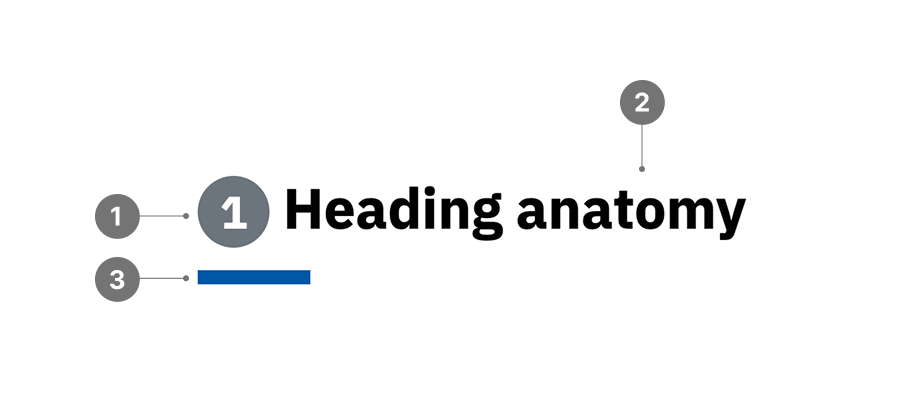
Heading anatomy
- Number
- Title
- Border
Heading levels

H1 Black/900 48px/2.67 rem
H2 Heading
1 H2 Heading
H2 Black/900 36px/1rem
H2 Heading
1 H2 Heading
H2 with border (border is 8px, primary blue 70)
H3 Heading
1 H3 Heading
H3 Bold/700 32px/1.78rem
H4 Heading
1 H4 Heading
H4 Inter Bold/700 24px/1.3rem
H5 Heading
1 H5 Heading
H5 Bold/700 20px/1.1 rem
H6 Heading
1 H6 Heading
H6 Bold/700 18px/1rem
Best practices
Follow these guidelines to use the Heading component effectively. These tips will help ensure your headings are both functional and accessible.
- Use headings to organize content and provide structure for readers.
- Ensure the page title is the only H1 on the page.
- Nest headings and order them sequentially (e.g., H2 followed by H3).
- Use sentence case for headings.
- Don’t use headings to modify font size or visual style.
- Avoid skipping heading levels (e.g., from H2 to H4).
- Do not use more than one H1 on a single page.
Examples
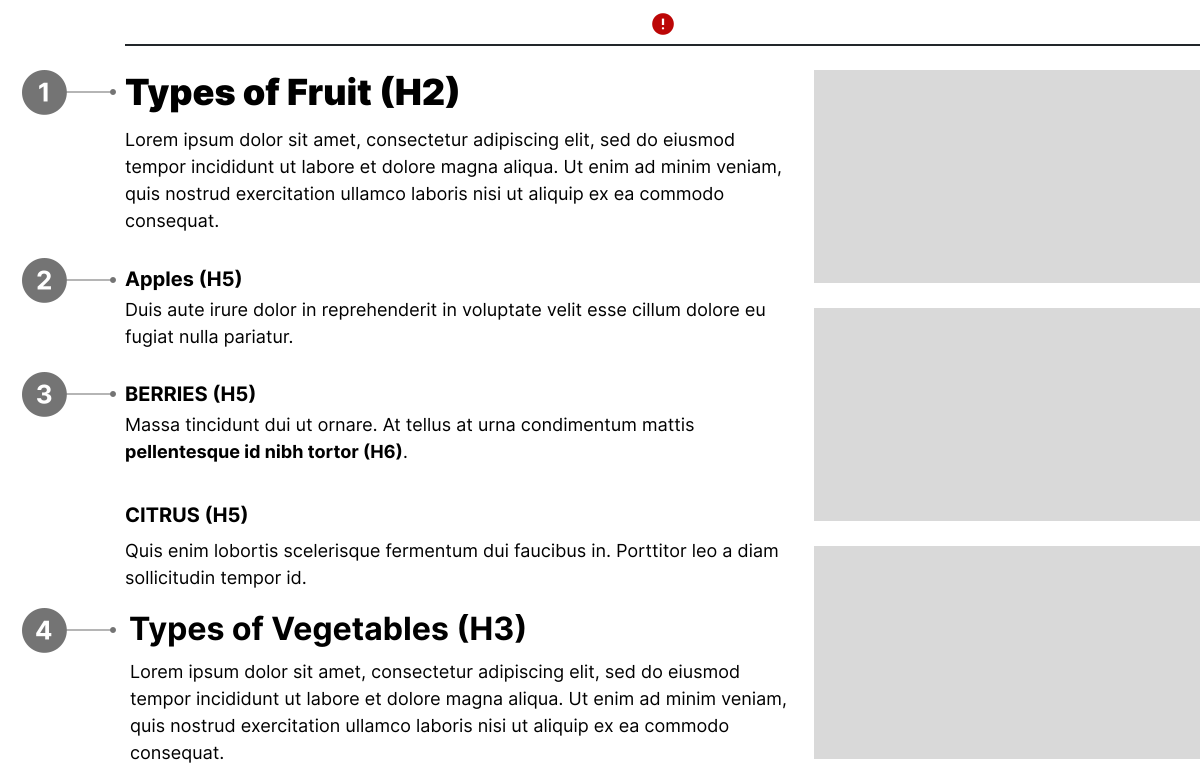
- Use sentence case, instead of Title Case.
- Follow proper hierarchy, headings should be ordered sequentially.
- Do not use all caps.
- This header should likely be an H2, since it's at the same level as types of fruit.
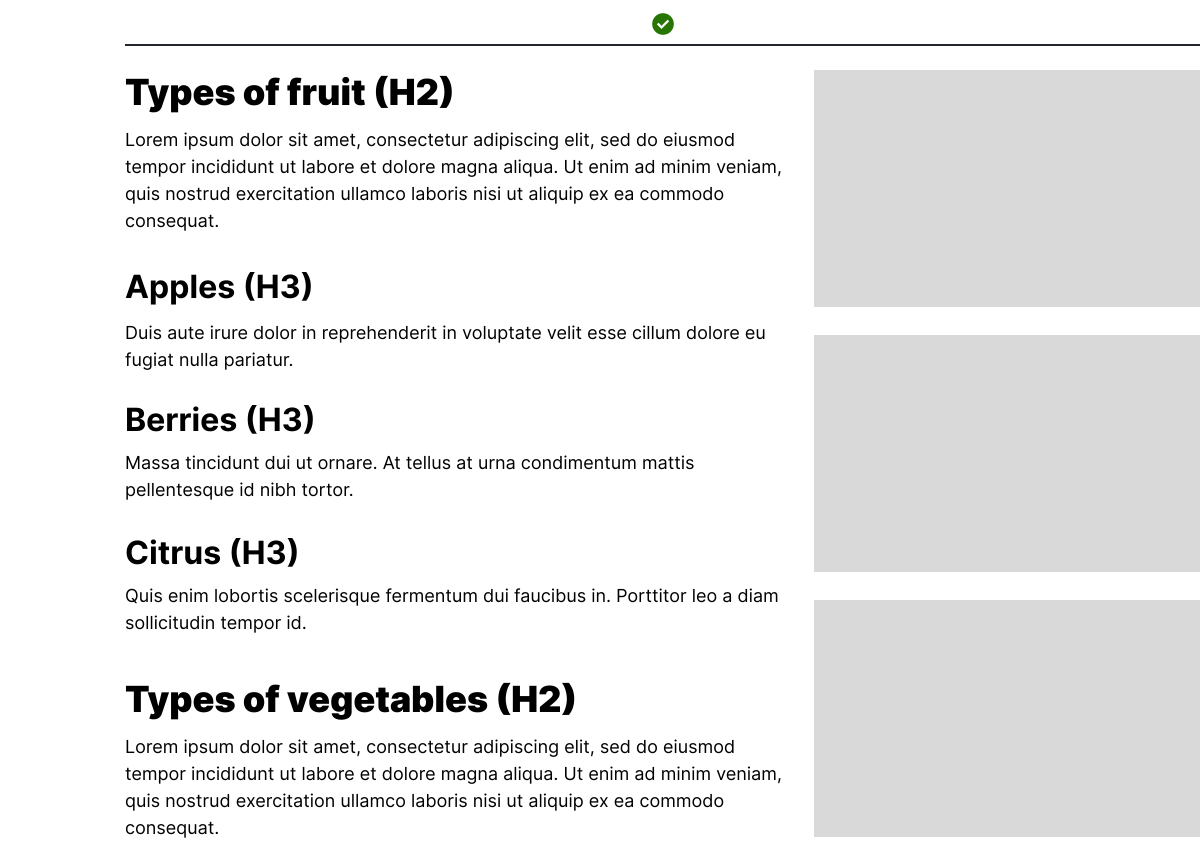
Good example: Follows proper hierarchy and best practice guidelines.
Placement
Headings can be placed anywhere below the H1 title and paired with any component to create a clear content hierarchy.
Heading characteristics
Pages automatically include an H1 title; use H2–H6 within the Heading component to structure all additional content.
- Keep headings user‑centered, short, and scannable.
- Maintain consistent spacing/padding for readability.
When using numeric labels:
- Use for steps, guidelines, or sequenced tasks.
- Write concise, action‑oriented headings that clarify order without overwhelming the reader.
- Move supporting details to the body text beneath the heading component.
- Remove the numeric input values to the Anchor ID.
Accessibility
Headings should be used to organize content and provide structure for readers. Refer to W3C article on Headings and Labels for more detail.
- Headings should not be applied to modify font size or visual style.
- Headings must be ordered sequentially, with no skipped heading levels. For example, do not set a heading level to H2 and then set the next heading level on the page to H4.
- The page title should be the only H1 on the page.
- Heading text should be unique and descriptive of the content within that section.
- Follow WCAG 2.1 guidelines for text spacing.
Web Coordinator checklist
- Apply proper hierarchy: Follow the sequential order (H1 to H6) without skipping levels.
- Assign IDs: For anchor links, assign IDs to headings.
- Limit H1 usage: Only one H1 should be used per page.
- Style consistently: Use sentence case and maintain consistent margin bottoms for whitespace.
- Check accessibility: Ensure font size and spacing comply with WCAG 2.1 guidelines.
- Follow Web Writing Style Guide best practices.
- If you check "Include numeric label" for the heading, include a whole number for the Number text field.
- Number text must be whole numbers (1, 2, 3, etc.) - they cannot be letters or decimal values.
- Number values must be applied manually, so ensure numbering is sequential and in logical order.
Updated February 6, 2026